
Are you wondering how to protect your eyes from a laser cutter while diving into your next DIY project?
I cover everything you need to know about laser eye protection, especially when using popular crafting tools like laser cutting machines.
I’ve been crafting for years, and let me tell you, nothing puts a damper on creativity like worrying about your safety precautions.
If you’re like me and need prescription glasses just to see the fine details of your work (and to tell my kids apart first thing in the morning), you’ll find this guide particularly helpful.
So let’s get into it and make sure your crafting is as safe as it is fun!


I get commissions for purchases made through some of the links in this post. There is no extra cost to you. See my full disclosure here.
Why Eye Protection is Crucial When Using Laser Cutters
The Sensitivity of the Human Eye to Laser Light
Your eyes are one of the most sensitive parts of your human body, and they’re particularly vulnerable to laser exposure.
According to the U.S. Army Public Health Center, laser eye protection (LEP) is a form of personal protective equipment (PPE) that can prevent ocular injuries from laser exposures.
The type of LEP you need depends on the wavelength of your laser and the optical density requirement.


Alternatives to Wearing Laser Eye Protection
If the idea of wearing laser eye protection doesn’t appeal to you, there’s an alternative option that prioritizes your eye safety without the need for goggles.
Certain laser engravers, like the xTool S1, don’t even require LEP. That’s because it’s an enclosed diode laser cutter.


This machine comes with Class-1 safety certification, meaning it’s designed to be eye-friendly and eliminates the need for additional eye protection.
Its enclosed design means that there’s no risk of laser leakage, and it even has a robust smoke extraction system to safeguard your overall well-being.
With the xTool S1, you can focus on your crafting projects without compromising on safety measures.
Why Choose xTool S1?
- First-class laser safety certification
- Faster and stable speed
- Brand new positioning method
- Dynamic-focus engraving
- Accessories like interchangeable laser modules, Riser Base, and Automatic Conveyor Feeder
Selecting the Right LEP
If you have a different type of laser machine, then you’ll need some protective eyewear.
When choosing LEP, you’ll often find the range or ranges of wavelength and the associated optical density (OD) etched onto the lens or arms of the glasses or goggles.
For example, an etching might read “400-550 nm OD 6+, 600-700 nm OD 4+.” This means that between 400 and 550 nm, the LEP will provide an OD of 6.0, and between 600 to 700 nm, an OD of 4.0.
Always use LEP that matches the wavelength output of your laser and meets or exceeds the OD recommendation.
Recommendations for Quality Laser Goggles
Types of Laser Goggles
Fiber Laser Safety Goggles
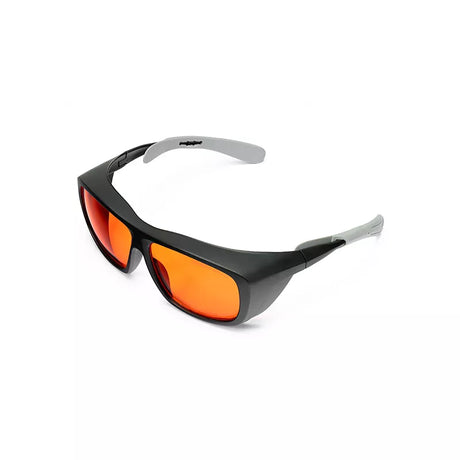
Pro: These goggles are designed to protect against a range of wavelengths, making them versatile. XTool Professional Laser Safety Glasses are a good option.
Con: Limit on the specific wavelengths that can be filtered. They only filter up to 540nm.
CO2 Laser Safety Goggles
Pro: These goggles are specifically designed for CO2 lasers, offering optimal protection against this type of laser radiation. Cloudray Safety Glasses are a popular choice.
Con: They can be more expensive than other types of laser goggles.
Diode, UV & Green Laser Safety Goggles
Pro: These goggles offer protection against a variety of lasers, including diode, UV, and green lasers. This pair of laser safety glasses from Amazon is a budget-friendly option.
Con: They may not offer the same level of protection as goggles designed for a CO2 laser.
Top Picks for Laser Eye Protection
My Number One Recommendation for CO2 Laser Engraving Eye Protection
If you’re looking for the best way to protect your eyes, consider XTool Safety Goggles. These goggles are designed to protect against a wide range of wavelengths, making them highly versatile.
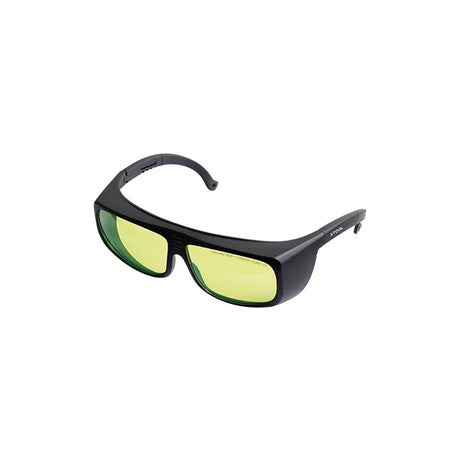
Pro: Offers protection against multiple wavelengths, making it versatile.
Con: The higher price point may not be suitable for everyone.
Army Medical Department’s Advice on Laser Eye Protection
According to the U.S. Army Public Health Center, the type of laser eye protection you need depends on the wavelength of your laser and the optical density requirement.
Always make sure to check the specifications of your goggles to ensure they meet your needs.
Remember, safety should always be your top priority when working with lasers.
Whether you opt for a high-quality machine like the xTool S1 that doesn’t require protective glasses or you invest in top-notch laser eye protection, make sure you’re taking the necessary precautions to protect your eyes.
Understanding Laser Hazards
The Risks
Lasers produce an intense, highly directional beam of laser light that can cause tissue damage, primarily thermal in nature. In the U.S., local laws around the use of lasers and protective measures are influenced by the Occupational Safety and Health Administration (OSHA).
OSHA states that the human body, especially the eyes, is vulnerable to laser output. In severe cases, the consequences of laser radiation exposure can lead to permanent damage.
OSHA Standards
OSHA has specific standards addressing laser hazards in general industry.
These standards provide construction information related to laser hazards in the workplace, references that may aid in recognizing laser hazards, and possible solutions for mitigating these hazards.
Following measures set by OSHA is a good idea for any laser operators.


Practical Tips for Laser Safety
Form and Function
Your LEP should fit well and be comfortable to wear. If you’re constantly adjusting your protective eyewear, you’re more vulnerable to laser exposure.
Glasses should protect the full front and sides of the eyes, and if they don’t fit closely enough to the face, consider using laser protective goggles instead.
This is so important, especially if you wear prescription glasses like me.
Storage and Maintenance
LEP should be stored in a room with the laser source or outside the door to the area where the laser hazard may be accessible.
They should be kept clean and stored away from UV exposure to maintain their effectiveness. Proper glasses storage is essential for your own protection.
Laser Safety Measures
- Laser Eye Protection: Protects your eyes from harmful laser beams.
- Ventilation System: Ensures that a large amount of dust, fumes, and particles are safely removed from the work area.
- Emergency Stop Button: Allows for immediate machine shutdown in case of an emergency, a feature especially important when dealing with high temperature lasers.


7 Tips to Protect Your Eyes When Using Laser Machines
- Choose the Right Laser Eye Protection (LEP): Always select goggles or glasses that match the wavelength output of your laser and meet or exceed the optical density recommendation.
- Consider Enclosed Laser Cutters: Machines like the xTool S1 come with Class-1 safety certification and eliminate the need for additional eye protection.
- Check Safety Standards: Make sure your LEP meets safety standards like those set by the U.S. Army Public Health Center or OSHA.
- Proper Fit and Comfort: Your LEP should fit well and be comfortable to wear. If they don’t fit closely enough to the face, consider using laser protective goggles instead.
- Storage and Maintenance: Keep your LEP clean and store them in a room with the laser source or outside the door to the area where the laser hazard may be accessible.
- Ventilation is Key: Ensure that your work area has proper ventilation to remove fumes and particles that could impair your vision and overall well-being.
- Emergency Stop Button: Always have an emergency stop button within reach for immediate machine shutdown in case of an emergency, to protect not just your eyes but your overall safety.


Conclusion
Whether you’re a seasoned crafter or new to the world of laser engraving, these safety precautions are crucial.
Always remember, a small price to pay for protective equipment can save you from the actual damage that can occur from unprotected exposure to lasers.
Stay safe and keep crafting! And hey, once you’ve got all your safety measures in place, why not explore how to turn your crafting into a profitable venture?
Trust me, you’ll want to check out my insights on making your laser engraving business profitable.
